
About the Authors

Washington, D.C., November 5, 2026 | Updated with results as of Thursday 9am ET
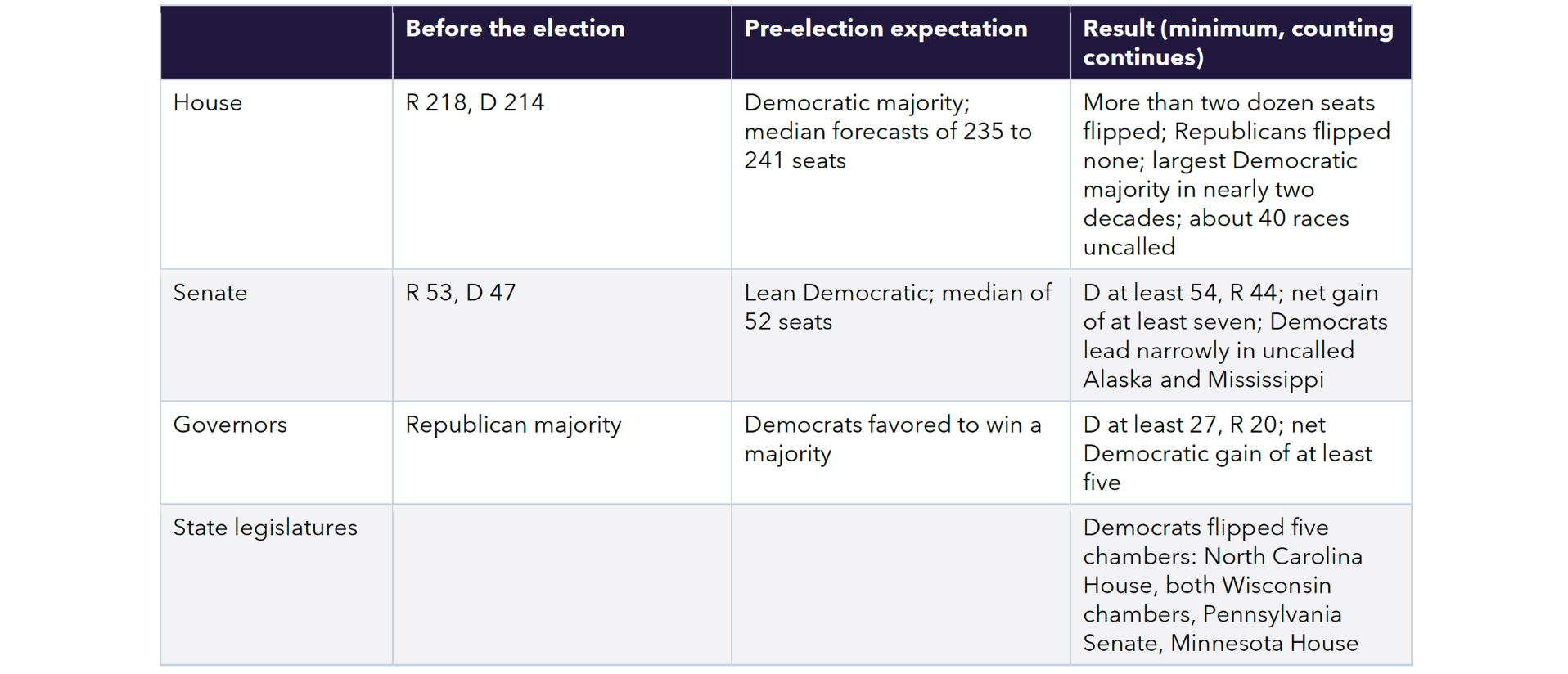
Counting continues. About 40 House races remain uncalled, and Democrats hold narrow leads in the uncalled Senate races in Alaska and Mississippi. Mississippi allows five business days for provisional and late mail ballots, Alaska accepts overseas ballots for up to 15 days and then runs its ranked-choice count, and California will take weeks. Figures below are minimums based on AP and Decision Desk HQ projections.
The bottom line
Democrats won a sweeping victory last night, taking control of both the House and the Senate in a decisive rebuke of President Trump. The party in the White House is expected to lose ground in a midterm, but this result goes beyond the historical pattern. It is only the seventh time, and the first since 2006, a president’s party has lost both chambers of Congress in a midterm.
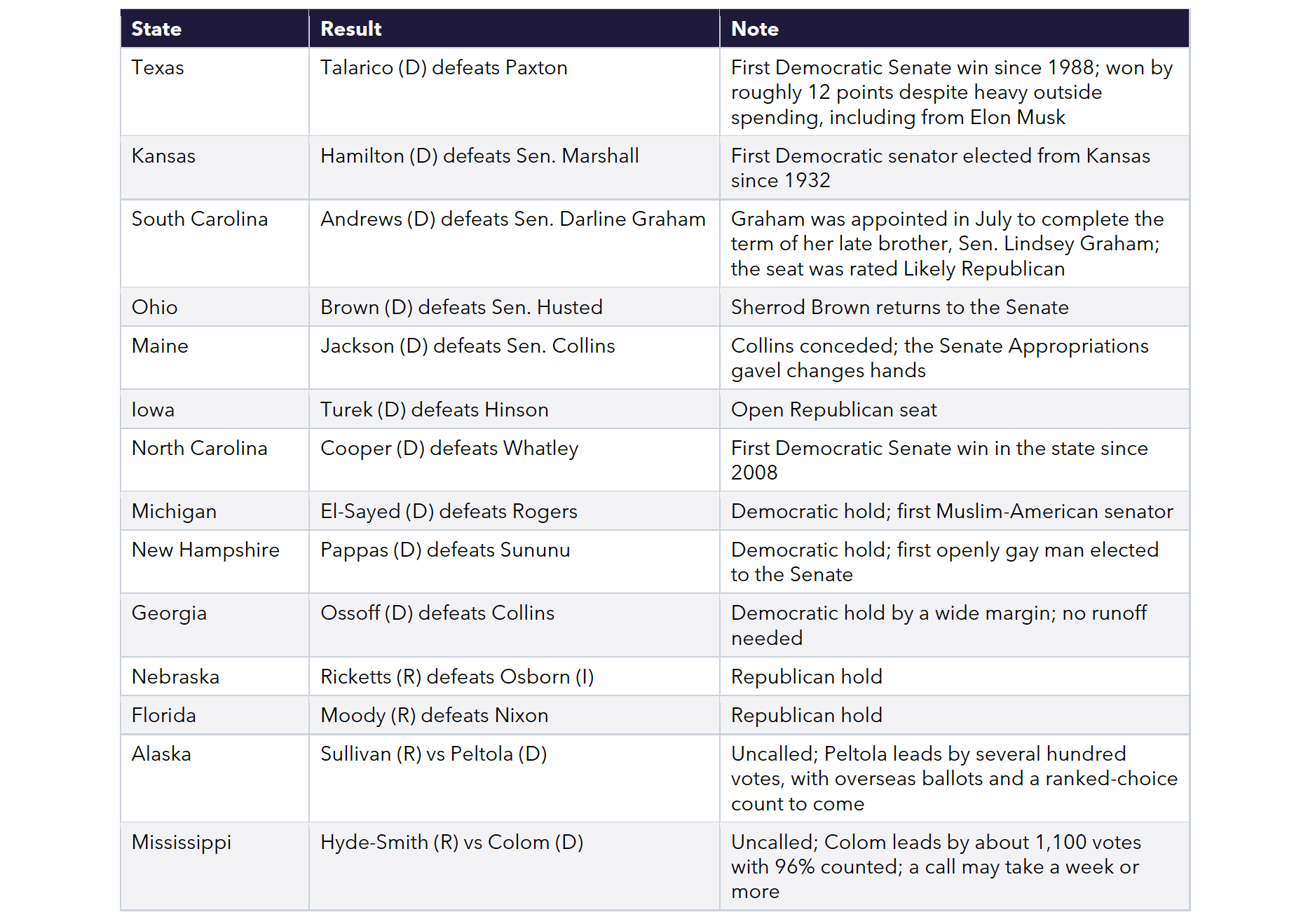
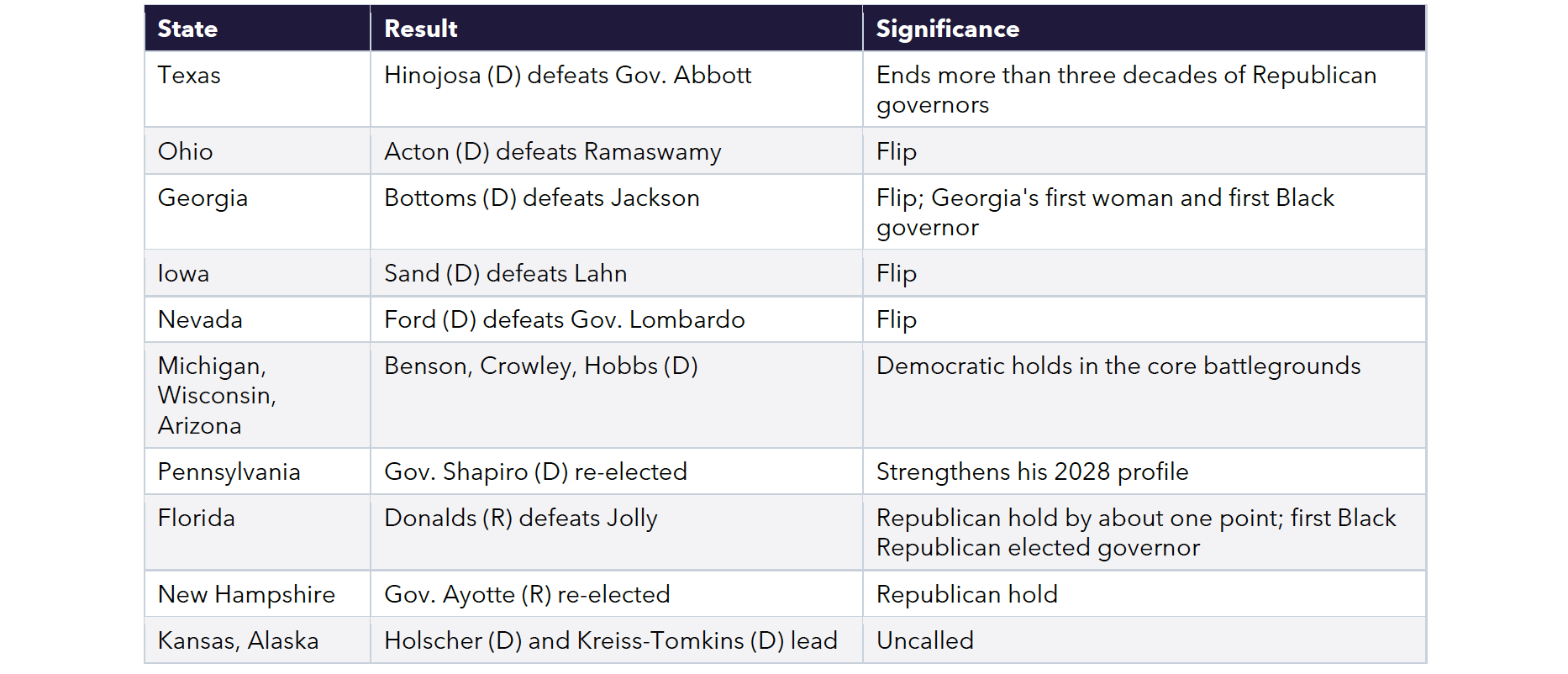
Virtually everything broke the Democrats’ way. They flipped at least seven Republican Senate seats, with two more still too close to call, including Texas, where James Talarico became the first Democrat to win a Senate race since 1988, and Kansas, where Adam Hamilton became the state’s first Democratic senator elected since 1932. Democrats also won a majority of governorships for the first time since 2010 and flipped five state legislative chambers.
The result is divided government for the final two years of the Trump presidency. Little of the administration’s agenda has moved through Congress since the 2025 tax and spending law, so the practical change is less about Democrats blocking a robust Trump legislative agenda and more about power of a different kind: investigations, subpoenas, control of spending bills, a veto over nominations and the ability to set the national agenda through hearings. Pressure will also grow on congressional Democrats to pass legislation that responds to voter concerns, forcing President Trump to either sign it into law or veto it.
The night also resets the 2028 race for both parties. For Republicans, it is a direct challenge to Trump’s leadership and opens the question of whether his chosen successor runs unchallenged. For Democrats, wins across every wing of the party leave the nomination wide open, with no single leader or direction emerging as the clear winner.
What drove voters
Affordability above all. The cost of living was the defining issue of the election, and gas prices made it impossible to miss. Gasoline averaged a record $4.15 a gallon on Election Day, driven by the conflict with Iran. In exit polling, 87% of voters said they were worried about gas and diesel prices, 88% about groceries and 86% about utility bills. Three in four said the economy is in poor shape, and 65% said the president’s policies had made it worse.
- The economy was the top issue for about four in ten voters, followed by the state of democracy at about three in ten. Cost of living and corruption were the two issues voters most often called crucial to their House vote (AP VoteCast).
- The Iran conflict compounded the economic pain. Sixty-two percent said the president was wrong to start the war, and four in ten called it a major factor in their vote.
- A referendum on Trump. About four in ten voters said they cast their ballot to express opposition to the president, against fewer than two in ten who voted to support him. His approval stood at 38% in exit polls, on track to be a record low for a president in a midterm.
- A demand for checks and balances. Seven in ten voters said Congress is not doing enough to check the president.
- The coalition shifted. Voters under 30 backed Democrats roughly 70-30 after splitting evenly in 2024, and Hispanic voters moved back toward Democrats.
- A warning for both parties: neither is popular. Just under half of voters view Democrats favorably, and about four in ten view Republicans favorably. The result was a rejection of the party in power more than an embrace of the opposition.
Results at a glance
The House
Democrats flipped more than two dozen House seats and are on track for their largest majority in nearly two decades, with about 40 races still uncalled. Republicans did not flip a single Democratic-held seat. In January, Hakeem Jeffries will become the first Black Speaker of the House. At least 14 Republican incumbents lost, including Brian Fitzpatrick in Pennsylvania, and Democrats swept all three Republican-held seats in Iowa.
Mid-decade redistricting, designed to protect the Republican majority, largely backfired in a wave environment. Across the nine states that redrew their maps, Democrats are on track to net 15 seats if current leads hold. Missouri voters also rejected their new Republican-drawn map outright.
A wide margin brings latitude and pressure
- Room to govern. A majority of this size can absorb defections on must-pass bills and still run an aggressive oversight agenda, unlike the narrow majorities of recent Congresses.
- Investigations and subpoena power. New Democratic chairs will take the gavels of House committees including Oversight, Judiciary, Energy and Commerce and Financial Services, along with their Senate counterparts. Expect early focus on tariffs and trade deals, the Iran conflict and war powers, federal workforce cuts, immigration enforcement and deals between companies and the administration.
- The overreach question. The size of the win creates its own pressure on Speaker Jeffries. An energized base will push for maximal investigations, and potentially impeachment. Leadership will want to avoid overreach that gives Republicans a 2028 message, and how Jeffries manages that tension will be the defining test of the new majority.
- The power of the purse. Every spending bill now runs through a Democratic House, turning funding deadlines into leverage over executive action.
The Senate
Democrats will hold at least 54 seats, a net gain of at least seven. They lead narrowly in both uncalled races, Alaska and Mississippi; winning both would give them 56. Four Republican senators lost: Susan Collins in Maine, Roger Marshall in Kansas, Jon Husted in Ohio and Darline Graham in South Carolina. It is the first time since 1954 that the party that won the Senate in one election lost it in the next. Chuck Schumer is expected to return as majority leader.
What Senate control decides
- Nominations. Democrats gain a veto over judges, cabinet officials and agency heads for the next two years. That is the single biggest constraint on the administration’s ability to govern through appointments.
- Investigations. A second set of subpoenas and higher-profile hearings.
- Legislation. The 60-vote filibuster remains, and the president retains the veto, which he has said he will use “liberally.” Bipartisan deals on permitting, appropriations and defense remain the realistic path for major bills.
The lame duck will be harder than usual
Anything the White House wants to finish before January runs into two problems. Republican margins in the current Congress are slim, and many of the Republicans who will cast those votes have little reason to help. Members the president pushed out or campaigned against, including Thom Tillis, John Cornyn and others, are leaving with no incentive to cooperate. Government funding runs out on December 11, and the defense authorization bill is still pending. Expect short-term extensions rather than ambitious deals.
Governors
Democrats will hold at least 27 governorships, a majority for the first time since 2010. They flipped Texas, Ohio, Georgia, Iowa and Nevada, and held Arizona, Michigan, Wisconsin and Pennsylvania. Governors matter more to business than their national profile suggests: they set the terms for state regulation, permitting, incentives and enforcement, and several will be 2028 contenders.
Ballot measures with national implications
- Abortion rights won again. Missouri voters rejected an amendment to reimpose most restrictions, and Virginia and Nevada enshrined abortion rights. Idaho rejected an abortion rights measure.
- Redistricting: Missouri rejected its new Republican-drawn congressional map, and Maryland approved an amendment that could allow new districts for 2028. The mid-decade map war is not over.
- Voter ID split: California and Colorado rejected voter ID measures; Ohio, North Carolina and Nevada approved them. Several states also wrote citizenship requirements for voting into law.
- Taxes: California’s proposed one-time 5% tax on billionaires’ assets was trailing in early returns. Florida approved a major property tax break.
The polling verdict
The polls called the wave, and if anything they underestimated it. Final averages showed a Democratic lead of about nine points on the generic ballot, and the results broadly matched or exceeded that. In Texas, the final polling average had Talarico ahead by about three points; he won by roughly twelve. After misses in 2016, 2020 and 2024, it is a vindication for a polling industry whose methods and credibility have been under sustained pressure.
Rising stars
- James Talarico (Texas): At 37, the Senate’s youngest member and the face of the night’s biggest upset.
- Abdul El-Sayed (Michigan): A progressive who won a battleground Senate seat, a data point for the party’s left.
- Adam Hamilton (Kansas) and Annie Andrews (South Carolina): Proof that Democrats can win in the deepest-red states with the right candidate and environment.
- Keisha Lance Bottoms (Georgia), Gina Hinojosa (Texas) and Amy Acton (Ohio): New Democratic governors in states the president carried.
- Josh Shapiro (Pennsylvania): A strong re-election that reinforces his standing for 2028.
What it means for 2028
Democrats. With wins across every wing of the party, no single leader or path to the White House emerges from last night. Progressives such as El-Sayed won, and Alexandria Ocasio-Cortez gains from the victories of candidates aligned with her. Centrists and moderates such as Cooper, Hamilton and Talarico won in states Trump carried. The breadth of the victory buoys everyone and gives anyone considering a run a credible argument. The nomination is wide open.
Republicans. The results are a direct challenge to Trump’s leadership and to the party’s direction after him. The central question is whether the 2028 nominee comes from within his sphere, such as JD Vance or Marco Rubio, unchallenged, or whether last night motivates a serious challenger such as Ron DeSantis. DeSantis has already moved: the day after the election, he called the results “close to an extinction-level event for Republicans” and argued the party in Washington should have governed more like Florida. He did not name the president, but it is an early signal of a path diverging from the administration. It would not be out of character for Trump to back someone outside his inner circle if he concludes that is the best way to protect his legacy. The president has blamed weak candidates rather than his own standing, and how the party responds will show how firm his grip remains.
The agenda ahead
Priorities for Congress
- Lame duck: government funding by December 11 and the defense authorization bill, most likely through short-term extensions.
- Must-pass bills in 2027: FY2028 appropriations, highway and transit programs and the farm bill. A divided Washington turns each into a negotiation over policy riders.
- The debt limit returns. The Treasury is expected to hit the $41.1 trillion limit in 2027 and exhaust extraordinary measures in late 2027 or early 2028. It is the new Congress’s biggest single point of leverage, landing in the run-up to the 2028 election.
- Bipartisan openings: permitting and grid reform, nuclear, AI and semiconductor competitiveness with China, critical minerals, shipbuilding and the defense industrial base.
- Issues that will define 2028 positioning: affordability (fuel, housing, electricity and health care), tariffs, the Iran conflict, corruption and AI’s effect on jobs and power prices.
Sectors facing more scrutiny
- Companies with direct deals with the administration: tariff exemptions, government equity stakes, settlements and merger approvals will draw document requests and hearings.
- Energy: fuel and electricity prices, LNG exports’ effect on domestic prices, and utility rate increases tied to data centers.
- Technology and AI: data center energy use, AI and jobs, children’s online safety, and federal preemption of state AI laws.
- Health care: drug pricing deals, insurer practices and the coverage effects of Medicaid and ACA changes.
- Financial services and digital assets: crypto policy, deregulation at banking agencies and conflict-of-interest questions.
- Defense and government contractors: Iran conflict spending, procurement and federal workforce reductions.
Sectors with new opportunity
- Bipartisan priority areas: nuclear, grid and transmission, semiconductors, critical minerals, shipbuilding and defense manufacturing.
- Affordability solutions: companies that can credibly show they lower costs for households will find a receptive audience in both parties heading into 2028.
- The states: with Democrats now controlling a majority of governorships and more legislatures, state capitals will drive more policy and compete harder for investment.
What it means for business
- Oversight risk rises sharply. Two Democratic chambers mean more hearings, document requests and public scrutiny. Preparation now is cheaper than response later.
- Executive action becomes the administration’s main tool. Expect more executive orders, tariffs and agency action, more vetoes, and the courts as the primary check. Regulatory volatility does not decline.
- States become more important. Governors, legislatures and attorneys general will drive more of the agenda that affects companies directly.
- Trade and tariffs stay with the White House. Congress cannot easily roll back tariffs, so the new majority changes the scrutiny, not the policy. Expect hearings on tariff impacts and trade deals with partners such as the EU, Japan and Korea.
- Foreign policy: a Democratic Congress will press on war powers in the Iran conflict, support for Ukraine and alliance commitments. Allies will read the result as a signal about US direction after 2028.
- Investment: bipartisan support for onshoring in strategic sectors continues, but deals negotiated directly with the administration will face closer scrutiny.
What companies should do now
- Map exposure to the new majority’s oversight agenda and to the incoming committee chairs.
- Build relationships with members and staff of the new majorities before committee agendas are set in January.
- Prepare for scrutiny: document readiness, hearing preparation and a clear public narrative on the issues most likely to be raised.
- Position for 2028: connect corporate priorities to affordability, competitiveness and jobs, which will frame the next presidential race.
Key dates
- Mid to late November: Final calls in Alaska, Mississippi, California and other slow-counting races.
- December 11: Government funding deadline.
- January 3, 2027: New Congress sworn in; Speaker Jeffries and the new committee chairs take over.
- 2027: FY2028 budget request, first oversight hearings of the new majorities and the debt limit.